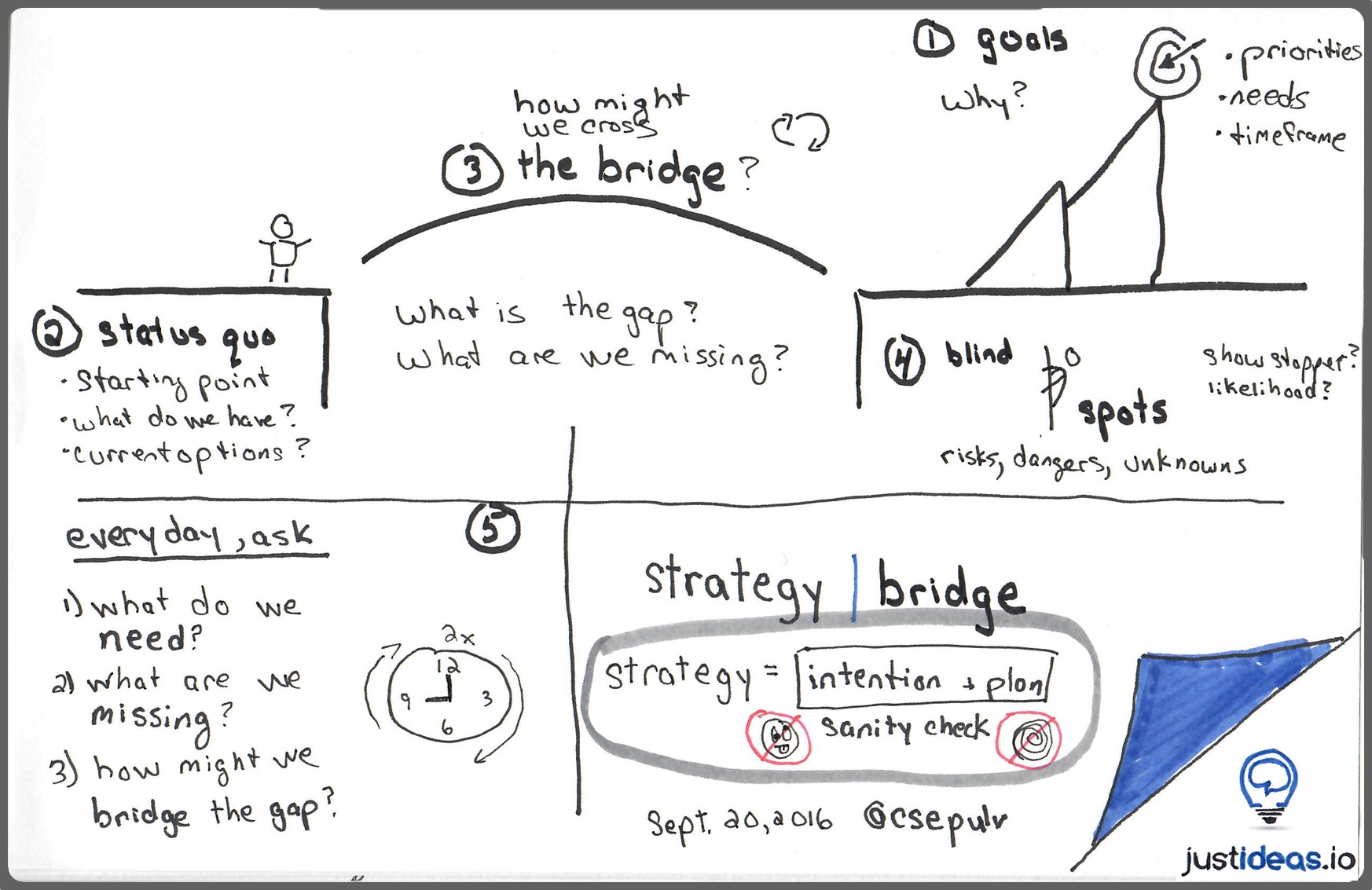
Strategy Bridge
Strategy can easily become lofty aspirations matched with a lot of homework. For me, strategy is intention with a plan, ideally with some sanity check to evaluate both. What do we want to accomplish? Why? How will we know if we did or did not do it?
The scope, complexity, timeframe, and number of people involved will vary, but these essentials stay the same.
My overall approach:
- Establish Goals
- Identify the Status Quo and the Gap
- Identify Risks, Constraints, and Noise
- Iterate on a plan from current state to goals (the bridge)
- Consider Blindspots
- Daily Strategy Standup (read this if nothing else)
The essentials: Why are you doing this? Is it worth the effort? What’s the payoff for all stakeholders? What do we need vs. want vs. nice-to-have? Priorities? Timeframe?
Status Quo: What is the Gap?
Section titled “Status Quo: What is the Gap?”Identify and understand your starting point. I’m trying to understand the gap between the status quo and where I want to be. In simple situations, there are only a few metaphorical speed bumps; in others, there’s the Grand Canyon.
Thinking in terms of a gap - “What are we missing?” - makes it easier to identify and enumerate needs and challenges.
Risks, Constraints, and Noise
Section titled “Risks, Constraints, and Noise”Are there limits to consider, such as a deadline? What are the risks or consequences for schedule or errors in approach? What’s the cost of an iteration?
What’s a distraction? What’s out of scope? What can be deferred?
Iteration: The Bridge
Section titled “Iteration: The Bridge”How might we bridge the gap between where we are and where we need to be? Draft an actionable plan. Baby steps you can implement are far better than ambitious ideas that need extensive research and planning.
Do a bit of work, evaluate, and tweak. Use your goals as a North Star and fill in the missing pieces. Or you may discover you should revise your goals.
Blindspots
Section titled “Blindspots”I like to combine risks and constraints into a general bucket of blindspots. You can only anticipate so much; there are always unknowns. Framing dangers as blindspots encourages me to be more creative in imagining what may undermine my efforts.
Strategy Stand-up
Section titled “Strategy Stand-up”Like the classic Agile daily stand-up, I hold a daily Strategy Standup. Whether alone or with a team, I ask three questions every day:
- What do we need?
- What are we missing?
- How might we bridge the gap between the two?
This 15-minute sanity check has proven very useful.
Strategy can too easily become ambitious planning, disconnected from tangible and actionable efforts. This approach helps me balance intention, focus, and adaptation.